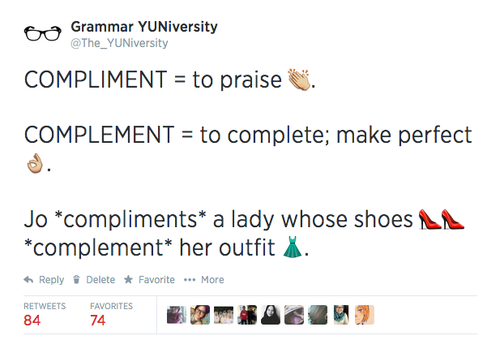
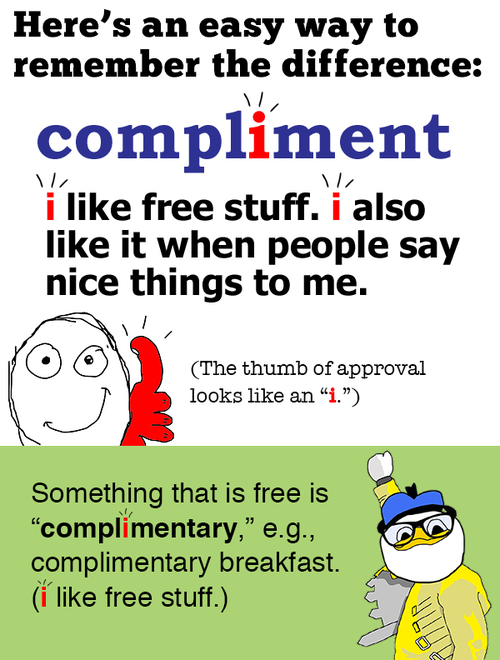
Here’s the difference between compliment and complement:
You won’t confuse these two words anymore, right?
Thursday, June 19, 2014
What's up with "compliment" and "complement"?
theyuniversity:




Friday, September 28, 2012
SoundsApp for sound English pronunciation
My lone student today in the morning had problems pronouncing a lot of consonant sounds in English. Now she has to brush up more on her pronunciation so I am recommending an iPhone app that could help her. It is called Sounds and it can be downloaded free in their website. A great website, "American" Clear Speech Sounds could also work wonders for her.
Friday, September 21, 2012
Fun learning English With Yejin
Had a fun time teaching English Yejin in the morning today. The video class was for 20 minutes and the lesson was on saying dates and holidays. I found out that she had problems making the TH sound, a problem which is common among young learners of English. So today I want to share some videos on how to say the TH sound in English. Enjoy the Friday and may you have more fun learning English! Have a great weekend everyone!!!
Tuesday, May 15, 2012

Thursday, March 15, 2012
Thursday, January 19, 2012
How to Speak Well and Confidently - wikiHow
Here is an article from wikiHow about how to speak well in conversations. Speaking is a vital skill when learning the English language. More so when it comes to speaking in public. Now to learn more about the correct stance and posture when you speak in public, I invite you to watch a video from the Virginia International University. Have fun learning!

via wikihow.com
Wednesday, December 28, 2011

Thursday, December 15, 2011
English for Information Technology - Essential English Skills for Information Technology
Computer specialists develop and maintain the computer equipment and software programs that form the basis of the Internet. They make up the majority of professional and related occupations, and account for about 34 percent of the industry as a whole. Computer programmers write, test, and customize the detailed instructions, called programs or software, that computers follow to perform various functions such as connecting to the Internet or displaying a Web page. Using programming languages such as C++ or Java, they break down tasks into a logical series of simple commands for the computer to implement.
Computer software engineers analyze user needs to formulate software specifications, and then design, develop, test, and evaluate programs to meet these requirements. While computer software engineers must possess strong programming skills, they generally focus on developing programs, which are then coded by computer programmers.
Computer systems analysts develop customized computer systems and networks for clients. They work with organizations to solve problems by designing or tailoring systems to meet unique requirements and then implementing these systems. By customizing systems to specific tasks, they help their clients maximize the benefit from investment in hardware, software, and other resources.
Computer support specialists provide technical assistance to users who experience computer problems. They may provide support either to customers or to other employees within their own organization. Using automated diagnostic programs and their own technical knowledge, they analyze and solve problems with hardware, software, and systems. In this industry, they connect with users primarily through telephone calls and e-mail messages.
Essential English for Information Technology
List of the Top 200 Information Technology Vocabulary
Speak about development needs using modals
Examples:
Our portal needs an SQL backend.
The landing page should inlude blog posts and an RSS feed.
Users can access use the tag cloud to find content.There must have been a bug in the software.
We can't have used that platform.
They might test our product if we ask.Speak about hypotheses (if / then)
Examples:
If the zipcode textbox is required for registration, users outside the US won't be able to join.
If we used C++ to code this project, we would have to hire some developers.
Our UI would have been much more simple if we had used Ajax.Examples:
There a lot of bugs in this code.
How much time will it take to ramp up this project?
Our client has a few comments about our mockup.Distinguish between countable and uncountable nouns
Examples:
Information (uncountable)
Silicon (uncountable)
Chips (countable)Examples:
Click on 'file' -> 'open' and choose your file.
Insert your user ID and password.
Create your user profile.Write business (letters) e-mails to clients
Examples:
Writing e-mails
Writing memos
Writing reportsExplain past causes for current situations
Examples:
The software had been installed incorrectly, so we reinstalled in order to proceed.
We were developing the code base when we were put on the new project.
The legacy software had been in place for five years before the new solution was designed.Examples:
Which error message do you see?
How often do you need to reboot?
Which software were you using when the computer screen froze?Examples:
What don't you install a new driver?
Let's create a wireframe before we go any further.
How about creating a custom table for that task?Information Technology Related Dialogues and Reading
Hooking Up My Computer
Hardware Deductions
Social Networking SitesInformation technology job description provided by the Bureau of Labor Statistics.
via esl.about.com
Friday, December 9, 2011
Interactive English
Interactive Exercises in English is good for intermediate and advance learners of English. The exercises offer a lot of practice on the use of idioms and expressions.

via abceda.com
Monday, December 5, 2011
The Funny Grammar Guide to Misused Words | Oxbridge Editing Blog
No matter how many spellings you learn, punctuation rules you master and grammar guides you read, it is still easy to make mistakes by using the wrong word, especially in cases where two words look or sound very similar. This is a particularly common problem due to the modern computer spelling and grammar check, which will pick up spelling errors and missing punctuation, but will not be able to detect that you have used the wrong word in a sentence.
Commonly confused words are often homophones (words that are spelled differently but sound the same) or just complex words with similar spellings. Often writers can be concentrating so hard on remembering how to spell a word correctly that they completely fail to notice that it isn’t the right word to use! We’ve chosen some commonly confused word groups and some funny, misspelled signs to help you avoid making the same mistakes in your own writing.
By, buy, bye and bi

This is a typical group of homophones – the words all sound the same but have completely different uses in the English language. They are commonly confused, as you can see from this embarrassing used-car company sign.
Just remember: by means next to, or may be used to describe how something is done.
For example: The cat is sitting by the fire. Or, turn on the television by pressing the green button.
Buy is a verb, meaning to purchase something.
For example: I am going to buy some chicken for dinner.
Bye is an abbreviation of the word ‘goodbye’, used when bidding somebody farewell.
For example: “Bye!” shouted Peter, as he ran down the drive.
Bi is a prefix added to some words to imply the sense of half or of a pair– much in the same way as the prefix ‘semi’.
For example: The festival takes place biannually.
There, their and they’re

This is perhaps the number one most commonly confused group of homophones, because all three words are used extremely frequently in the English language.
There is the trickiest one to remember, as it has two meanings: it might denote place, or can be used in the phrases ‘there is’ and ‘there are’.
For example: The shop is over there. Or, are there any apples left?
Their is used to denote plural ownership.
For example: They are doing their homework, at their house.
They’re is an abbreviation of the phrase ‘they are’, and can only be used in this context.
For example: They’re going swimming because they’re bored.
Other commonly misused word pairs

Look out for these other frequently misused word pairs and take extra care when writing them to make sure you have chosen the right word!
- Your (belonging to you) and you’re (you are).
- Accept (to take) and except (apart from).
- Affect (verb) and effect (noun).
- Cite (to refer to), site (location) and sight (vision).
- Desert (e.g. Sahara) and dessert (e.g. bannoffee pie!).
- Its (belonging to it) and it’s (it is).
- Practise (verb) and practice (noun).
- Stationary (still) and stationery (office supplies).
- Who’s (who is) and whose (belonging to who).


Tuesday, November 22, 2011

Wednesday, November 16, 2011
English Contractions - How to Use Contractions
Using Contractions
In everyday spoken English forms of the verb 'to be' and other auxiliary verbs are usually contracted:
Example: He's been to London, They aren't our neighbors
Here is a chart of when to use the most common contractions in English.
Auxiliary Form Contractions With Pronouns Contractions With Nouns Contractions With Question Words am I'm working this morning. - What'm I supposed to say? (common only in spoken English) is He's going to come. - She's a teacher. - It's easy! John's at work. - Mary's playing the piano at the moment. Who's on the telephone? - What's he doing? are You're a great friend! - They're playing golf this afternoon. The books're on their way. (common only in spoken English) What're you going to do? has He's been to Paris twice. - It's been such a long time! - She's lived there all her life. Mary's gone to the store. What's she been doing? - Who's been invited? have I've finished my homework. - They've got two cars. The students've finished their homework. (common only in spoken English) Where've you been all day? (common only in spoken English) had He'd been waiting for three hours. - We'd better be going. Jack'd worked there before he left. (common only in spoken English) What'd you done before that? (common only in spoken English) will I'll get you something to eat. - We'll be there soon. Peter'll catch the bus to work. What'll we do? Where'll you take us? would I'd like some fish. They'd love to ask you some questions. Jane'd love to come. Where'd you like to go? (common only in spoken English) Ads
Math Performance TasksStandards-Based Rubrics and Benchmark Paperswww.exemplars.com
English Program in JapanMeet the leading universities in Japan. Get your free entry now!uni.international.mext.go.jp/
Improve your Englishand experience the great city of London. Up to 44% discount. Book!www.schoolofenglish.org.uk
Rule: Do not use the contracted form of the auxiliary in formal writing
Example: Dear Mr Brown,
I would like to invite you to our company presentation ...
NOT!!: Dear Mr Brown,
I'd like to invite you to our company presentation ...
More Grammar Help
via esl.about.com
Friday, November 4, 2011

Wednesday, November 2, 2011
Beginning English Multiple Choice Tests
Beginning English Multiple Choice Test
Choose the correct word or phrase to complete each question. Each question has only one correct answer. When you are finished click on the "Next Question" button. There are 50 questions to this quiz. Try to use only 20 seconds per question. At the end of the quiz, you will receive quiz feedback.
Lower Level Review
Beginning English Grammar Review
Lower Intermediate English Grammar ReviewOther Grammar Review
A, An, The - Definite and Indefinite Article Review Quiz
Auxiliary Verb ReviewWas this quiz too easy? Here are quizzes for higher level learners.
Advanced Sentence Structure
Sentence Changes 1
Sentence Changes 2
Time Expressions ReviewVerb Form Quizzes
Past Tenses 1
Verb Forms 1
Verb Forms 2
Past or Perfect 1
Conditional Forms 1
More Quizzes
via esl.about.com
Friday, October 28, 2011
“Don't feel obligated to come if you're too busy.” - Daily English Phrases
You're having a party next weekend. You want to invite one of your friends, who's a very busy person. You don't want to make her feel pressured, so you say:
Don't feel obligated to come if you're too busy.
feel obligated to (do something)
"Feeling obligated" to do something means that you feel like you have to do it. People usually feel obligated to do things for social reasons, like because a friend or neighbor asked them to do it. For example:
I feel obligated to help because, you know, he helped us out a couple of months ago.
I don't really want to go, but I feel kind of obligated.
Don't feel obligated to (do something)
This is an expression that you can use when you're afraid that it will seem like you're pressuring someone too much to do something. In the example above, the speaker is worried that his invitation will make the friend feel that she has to come. He doesn't want to cause stress for her, so he says "Don't feel obligated..."
come (to an event)
When do you use "come" and when do you use "go" to talk about attending an event? Here are some guidelines:
- Use "come" to talk about an event that you're having at your house or office, or that you're organizing.
I'm having a party. Do you want to come?- Use "go" for an event that you're not going to attend.
I'm not going.- Use "go" for something that you're planning to go to, but use "come" to talk about the listener joining you:
I'm going to this Halloween party. Do you want to come?

via phrasemix.com
Wednesday, October 26, 2011
Top 5 short videos for Business English warm-ups | Teacher Training Blog
Here’s a small collection of short videos I’ve used to set the mood of Business English lessons, to provoke some interesting discussions and to promote some language noticing.
Negotiation – Fifth Element (film)
Specially funny for those who haven’t watched the film; or who don’t remember the scene. It works well in discussions on negotiating styles and cross-cultural differences.
Talent = 10,000 hours + luck
One of my favorites! So much material for discussion, and the guy speaks quite fast which is good to challenge students’ comprehension (and attention!); also a bit of bad language and sarcasm, just enough to be funny and critical at the same time.
Did you know? (Technology)
Not so up-to-date but still incredible. I often ask students to choose one of two pieces of data here and comment on them, trying to relate what they see in the video to their own lives.
Monty Phyton’s – Job Interview
Actually, this is my favorite! No much to say, just watch it and enjoy! Chances are you already did, but not one of my students had when I showed them, so even if it’s old, it’s new.
Hiring the Right People – Mark Zuckerberg
Quite challenging concepts here for those used to traditional recruitment processes where specific qualifications and lots of experience are the order of the day. This video is part of a series made by Stanford University.
And you? Any videos you use in Business English lessons? Let us know!
Monday, October 24, 2011


Friday, October 21, 2011
Word of the Day | placebo
placebo •\plə-ˈsē-(ˌ)bō\• noun
: an innocuous or inert medication; given as a pacifier or to the control group in experiments on the efficacy of a drug
The word placebo has appeared in 112 New York Times articles in the past year, including on Sept. 13 in “A Squirt of Insulin May Delay Alzheimer’s,” by Gina Kolata:
A small pilot study has found preliminary evidence that squirting insulin deep into the nose where it travels to the brain might hold early Alzheimer’s disease at bay, researchers said on Monday.
The study, published online in the Archives of Neurology, included 104 people, a group small enough that the promising results could have occurred by chance.
Researchers at the University of Washington divided the subjects into three groups. One got a placebo, one got 20 international units of aerosolized insulin a day, and the third got 40 international units a day.
… One hallmark of Alzheimer’s disease is reduced metabolism in the brain, which shows up on scans as less use of glucose, the fuel for brain cells. In this assessment, those getting insulin used more glucose in their brains; those taking placebos used less.
The Word of the Day and its definitions have been provided by the language-loving minds behind Vocabulary.com and the Visual Thesaurus.
Learn more about the word “placebo” and see usage examples across a range of subjects on the Vocabulary.com dictionary.
Click on the word below to map it and hear it pronounced:

Wednesday, October 19, 2011

Monday, October 17, 2011
Nice stories for kids in StoryBird
Since I was young, I have always loved reading stories. StoryBird has a big collection of stories for kids as well as the kids at heart. Read one story I saw today in StoryBird!
The Short but Sad Tale of a Girl Named Bella Luna by philomath on Storybird
Subscribe to:
Posts (Atom)